Lithium batteries outperform lead-acid batteries in cold storage warehouses due to superior efficiency, reliability, and safety. Operators face significant performance drops as temperatures fall. For example, battery efficiency can fall to 20% at -20°F, as shown below:
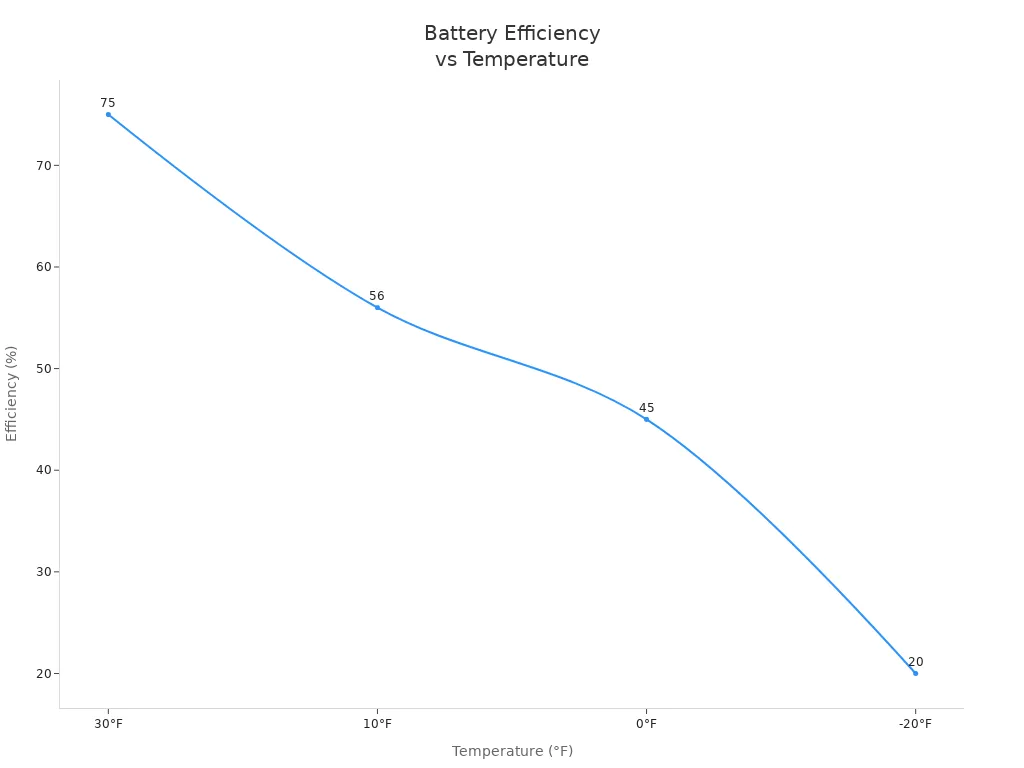
Jim Ripkey from Hy-Tek Material Handling Inc. notes that the choice between Lithium vs Lead-Acid Batteries in Cold Storage directly affects daily operations. Advanced solutions like BSLBATT LiFePO4 forklift lithium battery ensure consistent power, even in extreme cold.
Lithium vs Lead-Acid Batteries in Cold Storage
Efficiency and Capacity
Cold storage warehouses demand batteries that deliver consistent power, even as temperatures drop. Lithium vs Lead-Acid Batteries in Cold Storage show clear differences in efficiency and capacity. Lithium batteries maintain their performance across a wide temperature range, from -4°F to +140°F. Lead-acid batteries, on the other hand, lose significant capacity below freezing.
The following table highlights capacity retention for both battery types after six months at different temperatures:
Battery Type | Capacity at 0°C after 6 months | Capacity at 25°C after 6 months |
|---|---|---|
Lead-Acid | 97% | 90% |
Lithium-Ion | 94% to 80% | Varies based on charge level |
Lithium batteries also charge more efficiently in sub-zero environments. Lead-acid batteries struggle to accept a charge when cold, which leads to longer downtime and reduced productivity. In contrast, lithium batteries maintain their capacity and efficiency, ensuring equipment stays operational.
Reliability and Cycle Life
Reliability remains a top priority in cold storage operations. Lithium vs Lead-Acid Batteries in Cold Storage differ greatly in cycle life and discharge performance. Lithium batteries offer up to ten times the cycle life of standard lead-acid batteries. This extended lifespan reduces replacement frequency and lowers total cost of ownership.
The table below compares cycle life and discharge capacity at 0°F:
Battery Type | Cycle Life (approx.) | Performance in Cold Temperatures | Discharge Capacity at 0°F |
|---|---|---|---|
Lithium | 10 times that of SLA | Higher discharge capacity | 70% of rated capacity |
Lead-Acid (SLA) | Standard | Lower discharge capacity | 45% of rated capacity |
Lithium batteries deliver more consistent power output, even as temperatures fall. Lead-acid batteries experience voltage drops and reduced run times, which can disrupt warehouse operations. Lithium vs Lead-Acid Batteries in Cold Storage demonstrates that lithium technology supports longer shifts and fewer interruptions.
Safety and Risks
Safety is critical in cold storage environments. Lead-acid batteries present several risks, especially in low temperatures:
Lead exposure can cause serious health issues, including brain damage and developmental problems.
Sulfuric acid is highly corrosive and can result in severe injuries, such as permanent blindness.
Charging lead-acid batteries releases flammable gases, increasing the risk of explosions in enclosed cold storage areas.
Lithium batteries address many of these safety concerns. They operate safely across a wide temperature range, making them ideal for cold storage. Many lithium batteries feature integrated heaters that maintain optimal temperature, preventing performance degradation. The battery management system (BMS) monitors internal temperature, ensuring safe operation at all times.
Evidence Description | Explanation |
|---|---|
Lithium-ion batteries can operate in a wide temperature range, making them ideal for cold storage. | This versatility reduces safety risks in low-temperature environments. |
Special cold temperature-specific designs include integrated heaters. | Heaters maintain optimal battery temperature, preventing degradation and enhancing safety. |
The battery management system (BMS) monitors internal temperature. | The BMS ensures the battery remains at a controlled temperature, further mitigating risks during operations. |
Warehouse managers who compare Lithium vs Lead-Acid Batteries in Cold Storage will find that lithium batteries offer a safer, more reliable solution for demanding environments.
Cold Storage Challenges

Low Temperature Impact
Cold storage warehouses present unique challenges for battery-powered equipment. Low temperatures slow down the chemical reactions inside batteries. This leads to a significant drop in capacity and efficiency. For example:
Capacity can fall from 100% at 25°C to just 50-60% at -20°C.
Internal resistance increases, causing batteries to deplete faster.
Voltage drops become more common, making it harder for equipment to start and run smoothly.
At 0°C, lithium-ion batteries may lose 20-30% of their rated capacity.
At -10°C, they might deliver only about 70% of their normal power.
At -20°C, the loss can reach up to 50%.
These effects shorten run times and force operators to recharge or swap batteries more often. In the context of Lithium vs Lead-Acid Batteries in Cold Storage, lithium batteries still outperform lead-acid, but both types face performance drops in extreme cold.
Downtime and Maintenance
Downtime becomes a major concern in cold storage operations. A battery rated for 8 hours at 70°F may only last 4-5 hours at 0°F. One frozen food distributor reported that their forklifts experienced 90-minute shorter runtimes in cold storage, leading to 12 extra battery swaps each day. This resulted in 6 hours of lost productivity daily.
At 32°F: 20% capacity loss
At 0°F: 30-35% capacity loss
Below 0°F: Up to 50% capacity loss
Maintenance requirements also increase in cold environments. Lead-acid batteries need regular watering, cleaning, and corrosion checks. These tasks demand extra labor and time. Neglecting maintenance can cause battery failure or safety hazards. Lithium batteries require less upkeep, which helps reduce labor costs and the risk of unexpected downtime.
Operational costs rise quickly when batteries fail or need frequent attention. Warehouses that rely on lead-acid batteries often face higher expenses due to maintenance and lost productivity. Choosing the right battery technology can help minimize these challenges and keep operations running smoothly.
LiFePO4 Battery Advantages
Heating and Insulation
BSLBATT LiFePO4 batteries excel in cold storage environments due to advanced heating and insulation technologies. Each battery module includes active heating elements that allow operation at temperatures as low as -30°C. The battery management system (BMS) monitors internal temperature and activates heating when needed, preventing lithium plating and capacity loss. Board insulation and silicone desiccant help maintain stable temperatures and prevent condensation, which protects battery cells from moisture damage. Insulation retains heat generated during operation, while thermal management systems regulate temperature efficiently. These features ensure reliable performance and extend battery life in harsh warehouse conditions.
Active heating raises battery temperature from -20°C to 0°C in just 25-30 minutes.
IP67-rated enclosures shield batteries from ice and humidity.
Energy-efficient heating elements optimize charge and discharge cycles.
Fast Charging and Protection
LiFePO4 batteries offer significant advantages in charging speed and safety. Operators benefit from fast charging capabilities, with batteries reaching full charge in 2-3 hours, even after deep discharge. This rapid turnaround reduces downtime and keeps material handling equipment available for longer shifts. In contrast, lead-acid batteries may require up to 12 hours for a full charge.
BSLBATT integrates multiple protection features to enhance safety in cold environments. The IP67 enclosure prevents moisture intrusion, while built-in fire extinguishers and reserve mode ensure safe operation. Intelligent monitoring systems detect freezing risks and activate heating to maintain optimal battery status.
Feature | Description |
|---|---|
Active Heating | Prevents freezing and performance loss with intelligent monitoring of battery status. |
Moisture Protection | IP67 rated enclosure protects against condensation, ice, and humidity in cold environments. |
High Safety | Includes built-in fire extinguisher and one-button reserve mode for safe operation. |
Certification and Support
BSLBATT LiFePO4 batteries hold certifications that guarantee safety and reliability in extreme conditions. UL Solutions certifies models such as B-LFP48-615MH and B-LFP36-820MH for use in cold storage. IEC 62619 and IEC 62477 certifications further demonstrate compliance with international safety standards for commercial energy storage.
Certification | Models Certified | Description |
|---|---|---|
UL Solutions | B-LFP48-615MH, B-LFP48-460MH, B-LFP36-820MH | Ensures safety and performance in extreme conditions, including cold storage. |
IEC 62619, IEC 62477 | ESS-GRID C241 | Reflects reliability and safety for commercial energy storage systems. |
Facilities using BSLBATT batteries report reduced maintenance, lower energy costs, and longer battery lifespans. Dedicated technical support helps warehouse managers optimize battery performance and address operational challenges quickly.
Lithium vs Lead-Acid Batteries in Cold Storage show clear differences in performance, safety, and cost. LiFePO4 batteries maintain over 90% capacity in cold conditions, while lead-acid batteries lose up to 40%.
Cold temperatures impact AGM batteries much more than they impact LiFePO4 batteries. BSLBATT lithium battery solutions offer ruggedized design, fast charging, and near-zero maintenance. Warehouse managers should upgrade to LiFePO4 batteries for reliable operation, long lifespan, and lower total cost.
FAQ
How do lithium batteries perform in freezing temperatures?
Lithium batteries maintain higher capacity and efficiency in freezing temperatures. Integrated heating systems and advanced insulation help them deliver reliable power, even when the warehouse temperature drops below -20°C.
What maintenance do lead-acid batteries require in cold storage?
Lead-acid batteries need frequent watering, cleaning, and corrosion checks. Cold environments increase the risk of sulfation and electrolyte freezing, which can shorten battery life and raise maintenance costs.
Can operators charge lithium batteries quickly in cold storage?
Operators benefit from fast charging with lithium batteries. Most models reach full charge in 2-3 hours, even after deep discharge. Lead-acid batteries may require up to 12 hours for a complete charge.
Are lithium batteries safer than lead-acid batteries in cold environments?
Battery Type | Safety Features |
|---|---|
Lithium | BMS, heaters, sealed enclosure |
Lead-Acid | Venting required, acid risks |
Lithium batteries offer enhanced safety with integrated management systems and sealed designs. Lead-acid batteries present risks from acid leaks and gas emissions.
What certifications support lithium battery use in cold storage?
UL Solutions and IEC certifications validate lithium battery safety and reliability. BSLBATT LiFePO4 batteries meet these standards, ensuring compliance for commercial cold storage operations.