Regulation (EU) 2023/1542 establishes a phased compliance framework for all batteries placed on the European market, covering CE marking, carbon footprint declarations, supply chain due diligence, and the Digital Battery Passport. For industrial battery buyers and importers, understanding which obligations are already in force and which take effect through 2027 is essential for avoiding market access disruption and selecting compliant suppliers.
The European Union enacted Regulation (EU) 2023/1542 in July 2023, replacing the Batteries Directive 2006/66/EC and introducing the most comprehensive battery compliance framework in EU history. The regulation applies to all battery types placed on the EU market, including portable, industrial, automotive, electric vehicle (EV), and light means of transport (LMT) batteries. For companies sourcing industrial batteries such as forklift batteries and energy storage systems, the regulation introduces a series of phased obligations that started in August 2023 and extend through 2028 and beyond. This article outlines the core requirements, enforcement timelines, and what procurement teams should verify when evaluating battery suppliers.
What Is the EU Battery Regulation
Regulation (EU) 2023/1542, commonly referred to as the EU Battery Regulation, was published in the Official Journal of the European Union in July 2023 and entered into force on 18 August 2023. Mandatory enforcement began on 18 February 2024. From 18 August 2025, the regulation fully replaced the previous Batteries Directive 2006/66/EC, with limited transitional provisions remaining.
The regulation applies directly across all EU member states and covers the entire battery lifecycle, from raw material sourcing and manufacturing through to reuse, collection, and recycling. It imposes obligations on manufacturers, importers, distributors, and fulfillment service providers. Online marketplaces are also required to ensure that products listed on their platforms meet compliance requirements.
The framework targets five battery categories: portable batteries, industrial batteries, automotive batteries, EV batteries, and LMT batteries. Each category carries specific requirements and phased deadlines. Industrial batteries, including those used in forklift trucks and stationary energy storage systems above 2 kWh, are subject to some of the most detailed obligations under the regulation.
Key Requirements Under the Regulation
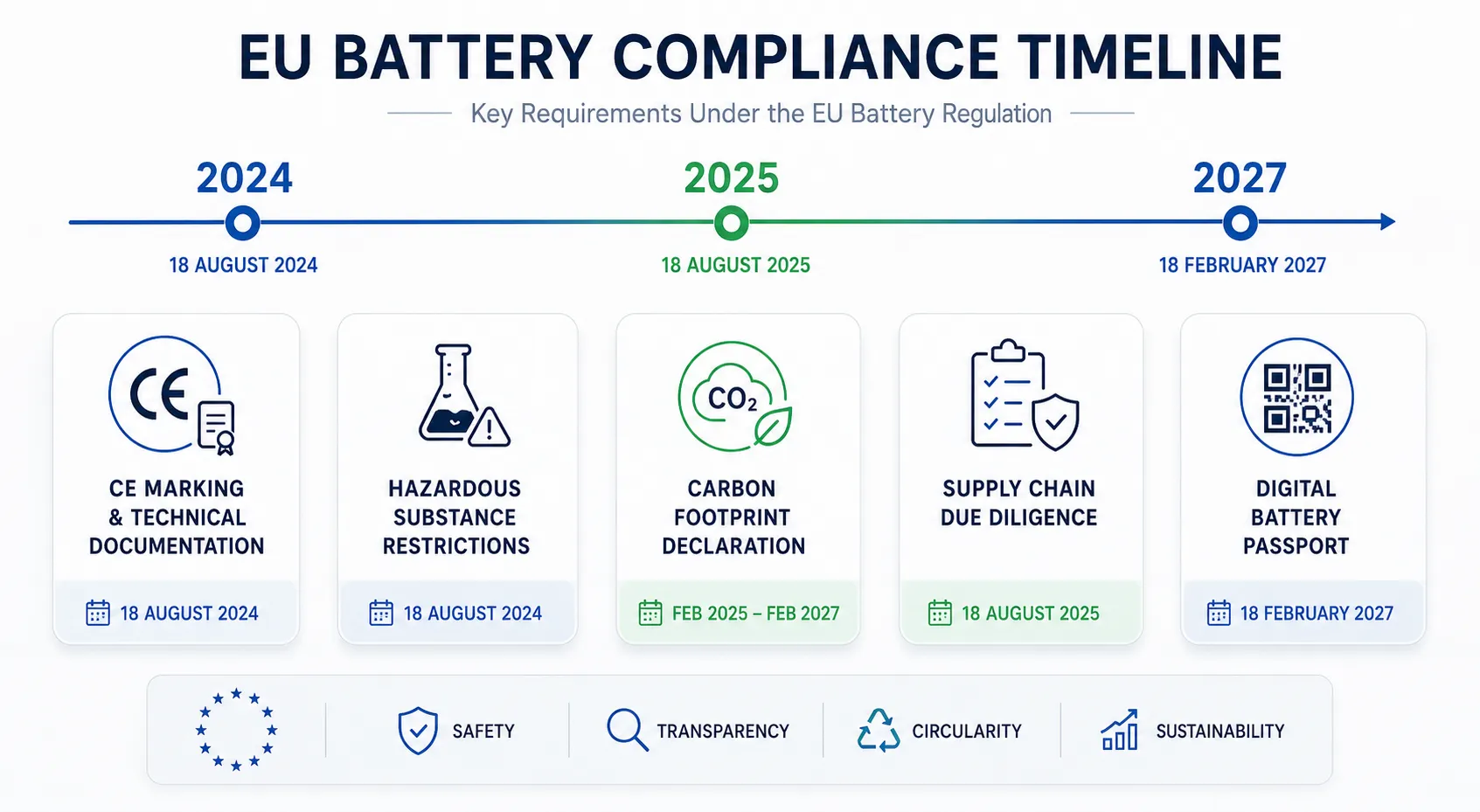
CE Marking and Technical Documentation
From 18 August 2024, all batteries placed on the EU market must carry CE marking. This requires manufacturers and importers to demonstrate compliance with the safety and performance standards defined in the regulation, supported by technical documentation and testing procedures. The CE marking must be affixed to the battery before it enters the market or is put into service. Technical files must be maintained and made available to market surveillance authorities upon request.
Hazardous Substance Restrictions
The regulation sets clear concentration limits for hazardous substances across all battery types. Lead content must remain below 0.01% by weight, a requirement that took effect in August 2024. Mercury is restricted to a maximum of 0.0005% by weight, and cadmium must not exceed 0.002% by weight. Batteries containing more than 0.004% lead or more than 0.002% cadmium must carry the corresponding chemical symbol (Pb or Cd) as part of their labelling.
Carbon Footprint Declaration
Carbon footprint requirements are being phased in by battery category. For EV batteries, carbon footprint declarations became mandatory from February 2025. For rechargeable industrial batteries above 2 kWh and LMT batteries, declarations must be calculated and disclosed using the methodology established by the European Commission, with the declaration accompanying the battery until 18 February 2027 when the Digital Battery Passport takes over.
The carbon footprint calculation covers the full lifecycle of the battery, including raw material extraction, manufacturing, transportation, and end-of-life processing. Companies that have not yet begun collecting this data are advised to start immediately, as the lead time required for supply chain mapping and data aggregation is considerable.
Supply Chain Due Diligence
Due diligence obligations under Article 48 and Annex X of the regulation took effect from 18 August 2025. Producers and producer responsibility organizations are required to adopt and communicate a due diligence policy, establish internal management systems to support that policy, identify and assess supply chain risks, and implement strategies to address identified risks. Third-party verification by a notified body is mandatory. The scope covers sourcing of critical raw materials including cobalt, lithium, nickel, and natural graphite.
Digital Battery Passport
From 18 February 2027, industrial batteries above 2 kWh, EV batteries, and LMT batteries must be accompanied by a Digital Battery Passport. The passport is accessible via a QR code affixed to the battery and must contain material pathways, product specifications, performance and durability data, and lifetime information. This requirement is designed to support circular economy goals by enabling reuse, remanufacturing, and recycling at end of life.
The Digital Battery Passport represents the most operationally demanding requirement for most manufacturers. Building the data infrastructure to generate and maintain passports at scale requires significant internal preparation, particularly for companies managing large and complex supply chains.
Compliance Timeline at a Glance
The regulation follows a phased enforcement schedule, with obligations introduced gradually from 2023 through 2028. Some requirements, such as CE marking and hazardous substance restrictions, are already in force. Others, including the Digital Battery Passport and minimum recycled content rules, will take effect in the years ahead. The table below summarizes the key milestones.
Date | Obligation |
August 2023 | Regulation (EU) 2023/1542 entered into force |
February 2024 | Mandatory enforcement begins; CE marking requirements apply |
August 2024 | Lead restriction (<0.01% by weight) and enhanced labelling take effect |
August 2025 | Replaces Batteries Directive 2006/66/EC; supply chain due diligence obligations begin |
February 2027 | Digital Battery Passport becomes mandatory for industrial batteries >2 kWh, EV, and LMT batteries |
August 2028 | Minimum recycled content requirements take effect |
Companies placing industrial batteries on the EU market should note that preparation time for upcoming obligations is significant. Carbon footprint data collection, supply chain mapping, and Digital Battery Passport infrastructure each require internal resources and supplier coordination well in advance of the formal deadlines.
What This Means for Industrial Battery Procurement
For procurement teams sourcing industrial batteries for use or resale within the EU, the regulation creates several practical verification requirements. Evaluating supplier compliance is no longer limited to price, performance, and delivery; it now includes assessing whether a supplier can provide the documentation and certifications required for EU market access.
The minimum baseline for EU compliance today includes CE marking against the regulation requirements and adherence to hazardous substance limits. Buyers should request copies of technical documentation and test reports confirming substance concentrations. For batteries above 2 kWh, buyers should also ask suppliers about their timeline and readiness for carbon footprint declarations and the Digital Battery Passport.
Relevant product certifications that overlap with the regulation requirements include IEC 62619, which covers safety requirements for secondary lithium cells and batteries for use in industrial applications, and UN38.3, which governs transport testing. ISO 9001 certification indicates a quality management system capable of supporting the documentation and process controls required for ongoing compliance. These certifications do not replace EU-specific compliance obligations, but they demonstrate that a supplier operates within a structured quality and safety framework.
For companies that have committed to supply chains running through 2027 and beyond, verifying that a supplier is actively preparing for the Digital Battery Passport is a practical procurement consideration. Suppliers without a clear roadmap for passport implementation may create market access risk for buyers closer to the February 2027 deadline.
How BSLBATT Supports EU Compliance
BSLBATT manufactures industrial lithium batteries for forklift, energy storage, and golf cart applications, with products deployed across more than 100 countries. All products intended for the European market are CE certified and supported by the technical documentation required under Regulation (EU) 2023/1542.
Current certifications held by BSLBATT include:
- CE marking in accordance with EU Battery Regulation requirements
- IEC 62619: Safety requirements for secondary lithium cells and batteries for use in industrial applications
- 3: Transport testing for lithium batteries
- ISO 9001: Quality management system certification
On carbon footprint declarations, BSLBATT supports customers in accessing supply chain data relevant to their own carbon reporting requirements. On the Digital Battery Passport, BSLBATT is tracking the implementation timeline for the February 2027 mandate and preparing the data infrastructure necessary to meet the requirement for industrial batteries above 2 kWh.
Procurement teams requiring compliance documentation, technical datasheets, or information about certification status for specific product models are encouraged to contact the BSLBATT technical sales team directly.
FAQ
Does the EU Battery Regulation apply to industrial forklift batteries?
Yes. The regulation covers industrial batteries, which includes lithium batteries used in forklift trucks and other industrial handling equipment. Industrial batteries above 2 kWh are subject to specific requirements including carbon footprint declarations and the Digital Battery Passport mandate from February 2027.
When does the Digital Battery Passport become mandatory?
The Digital Battery Passport becomes mandatory on 18 February 2027 for industrial batteries above 2 kWh, EV batteries, and LMT batteries. The passport must be accessible via a QR code and contain material pathways, product specifications, and lifetime data.
What certifications should EU buyers require from battery suppliers?
At minimum, buyers should require CE marking under Regulation (EU) 2023/1542, confirmation of hazardous substance compliance, and relevant product safety certifications such as IEC 62619 and UN38.3. ISO 9001 certification provides additional assurance of systematic quality management. For long-term supply relationships, buyers should also verify that suppliers are preparing for carbon footprint declarations and the Digital Battery Passport.
Is carbon footprint declaration already required for industrial batteries?
Carbon footprint declarations for EV batteries became mandatory from February 2025. For rechargeable industrial batteries above 2 kWh, the obligation is being phased in according to the timeline established by the European Commission. Companies are advised to begin collecting supply chain carbon data now, given the significant preparation time required.
What replaced the EU Batteries Directive 2006/66/EC?
Regulation (EU) 2023/1542 replaced the EU Batteries Directive 2006/66/EC from 18 August 2025, with limited transitional provisions. Unlike a directive, the regulation applies directly in all EU member states without requiring transposition into national law, creating a single harmonized compliance framework across the EU.