Battery energy storage systems come in various types, including lithium-ion, lead-acid, and flow batteries, each suited to different applications. Choosing the right battery depends on factors such as capacity, durability, and maintenance needs. Lithium-ion options are widely used in homes due to their high energy density and long life, while flow batteries are ideal for large-scale projects thanks to their scalability and long cycle performance. Additionally, most battery systems can be recycled, helping recover valuable materials and protect the environment.
Battery Energy Storage Systems have many main types. These include lithium-ion, lead-acid, flow, sodium-ion, zinc-air, nickel-cadmium, and solid-state. Each type works in its own way. Each one has good points and bad points. People pick these batteries for different reasons. Some reasons are how long they last or how much energy they hold. The table below shows where these batteries are often used:
|
Battery Type |
Common Applications |
|---|---|
|
Lead-Acid Batteries |
Off-grid power systems, backup power supplies (UPS) |
|
Flow Batteries |
Grid-scale storage |
|
Zinc-Air Batteries |
Backup power systems, small-scale energy storage |
|
Nickel-Cadmium (NiCd) |
Backup power systems, industrial settings, remote off-grid locations |
|
Sodium-Sulfur (NaS) |
Utility-scale energy storage, load balancing on the grid |
What Is a Battery Energy Storage System (BESS)?
A battery energy storage system (BESS) is a technology that stores electrical energy in rechargeable batteries and releases it on demand. Also referred to as an energy storage system (ESS), these systems convert surplus electricity into chemical energy during low-demand periods, then discharge it back to the grid or facility when power is needed.
A BESS typically consists of four core components: battery cells that hold the stored energy, a Battery Management System (BMS) that monitors and protects cell performance, a Power Conversion System (PCS) that handles AC/DC conversion, and a thermal management system that keeps operating temperatures within safe limits.
These systems are central to modern energy infrastructure. In 2022, global investment in battery storage exceeded USD 20 billion, with over 65% directed toward large-scale grid applications — a figure
projected to surpass USD 35 billion in 2023. For industrial and commercial operators, BESS installations reduce peak demand charges, provide backup power during outages, and improve renewable energy utilization rates by up to 80%.
For a deeper look at how these systems work and what drives their performance, see how battery energy storage systems store and release power.
7 Main Types of Battery Energy Storage Systems
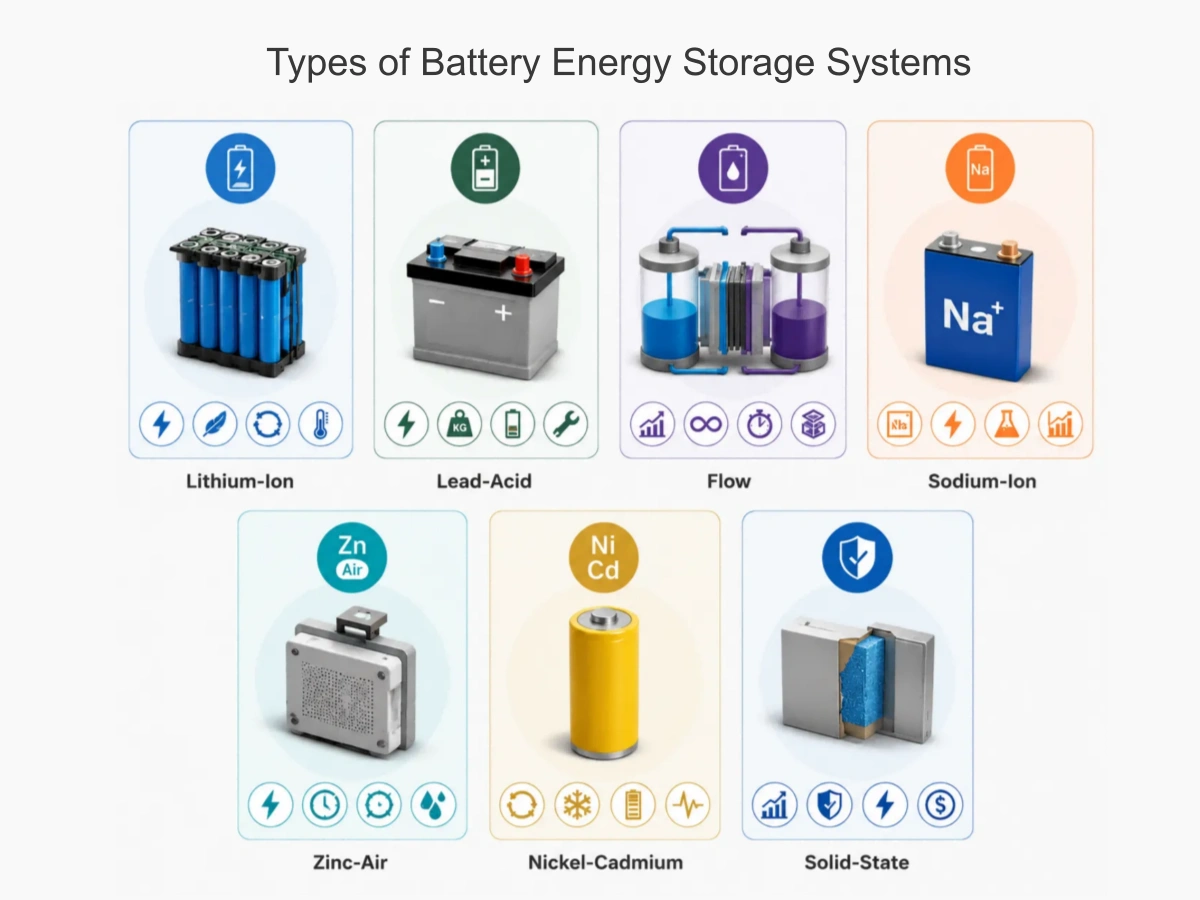
Battery energy storage systems are not a single technology. Different chemistries serve different performance requirements, and choosing the right type depends on factors such as cycle life, energy density, installation scale, and total cost of ownership. The seven main types in commercial and industrial use today are outlined below.
Lithium-Ion Battery Storage Systems
Lithium-ion batteries store energy by moving lithium ions between the anode and cathode through a liquid electrolyte. As shown in the diagram above, key characteristics include high power output, low self-discharge, long cycle life, and stable thermal performance. Two primary chemistries dominate stationary energy storage: lithium iron phosphate (LFP) for thermal stability and cycle life, and nickel manganese cobalt (NMC) for higher energy density where space is constrained. They are currently the most widely deployed BESS technology across commercial, industrial, and grid applications.
Lead-Acid Battery Storage Systems
Lead-acid batteries generate electricity through a reaction between lead plates and a sulfuric acid electrolyte. The diagram highlights their defining traits: high surge current capability, significant physical weight, lower energy capacity per unit size, and a design that requires periodic maintenance. Available in flooded (FLA) and valve-regulated (VRLA) variants, they are one of the oldest rechargeable technologies still in active deployment. Low upfront cost makes them a practical choice for backup power and off-grid systems where capital budget is the primary constraint.
Flow Battery Energy Storage Systems
Flow batteries store energy in liquid electrolytes held in external tanks, pumped through an electrochemical cell during operation. The diagram reflects their core strengths: scalable capacity, virtually unlimited cycle life, fast response times, and modular system architecture. Power output and storage capacity are independently configurable, making them well suited to long-duration grid-scale storage. Vanadium redox flow batteries (VRFB) are the most commercially mature variant in active deployment today.
Sodium-Ion Battery Storage Systems
Sodium-ion batteries operate on the same charge transport principle as lithium-ion but substitute sodium ions for lithium. As the diagram indicates, they combine raw material abundance, competitive energy output, stable chemistry, and strong cost scalability. Sodium is significantly more available and cheaper to source than lithium, reducing supply chain risk. The technology is gaining commercial traction in stationary storage applications where cost competitiveness is prioritized over peak energy density.
Zinc-Air Battery Storage Systems
Zinc-air batteries produce electricity through the oxidation of zinc using oxygen drawn from ambient air. The diagram points to their high power potential, extended runtime, and sensitivity to moisture as defining characteristics. Using air as one reactant allows for a high theoretical energy density relative to physical size. Current commercial deployments are concentrated in controlled backup environments, while rechargeable variants for broader grid applications continue to mature.
Nickel-Cadmium Battery Storage Systems
Nickel-cadmium batteries use nickel hydroxide and cadmium electrodes with a potassium hydroxide electrolyte. The diagram highlights their long cycle life, reliable cold-weather performance, stable energy capacity, and consistent discharge behavior. These properties make NiCd a field-proven choice for industrial backup systems and remote off-grid installations operating in low-temperature environments where other chemistries underperform.
Solid-State Battery Storage Systems
Solid-state batteries replace the liquid electrolyte with a solid ionic conductor. As shown in the diagram, the technology is defined by its capacity growth potential, enhanced safety profile, high charge efficiency, and cost reduction trajectory as manufacturing scales. Eliminating liquid electrolyte removes the flammability risk associated with conventional systems and enables higher energy density. Commercial availability for grid-scale storage is currently limited, with broader deployment expected as production processes mature.
Battery Energy Storage System Comparison: Key Specs
How It Works
Every battery type stores and gives out energy in its own way.
Lithium-ion batteries move lithium ions back and forth. This helps them charge fast and hold lots of energy.
Lead-acid batteries use a reaction between lead plates and acid. They must stay charged or they can get ruined.
Flow batteries keep energy in liquids. Pumps push these liquids through a cell to make power.
Sodium-ion batteries work like lithium-ion but use sodium instead.
Zinc-air batteries use air and zinc to make electricity.
Nickel-cadmium batteries use nickel and cadmium plates for a reaction.
Solid-state batteries use solid stuff, not liquids, so they are safer and stronger.
Pros and Cons
Each battery has good and bad sides:
Lithium-Ion:
Pros: Holds lots of energy, lasts long, needs little care
Cons: Can get too hot, costs more
Lead-Acid:
Pros: Cheap, easy to buy
Cons: Heavy, does not last as long, needs care
Flow:
Pros: Lasts a long time, easy to make bigger
Cons: Big and heavy, costs a lot
Sodium-Ion:
Pros: Safer, uses easy-to-find stuff
Cons: Does not hold as much energy
Zinc-Air:
Pros: Holds lots of energy
Cons: Does not last long, air moisture can hurt it
Nickel-Cadmium:
Pros: Works well in cold, lasts a long time
Cons: Not good for the earth
Solid-State:
Pros: Very safe, holds lots of energy
Cons: Costs a lot, hard to find
Typical Applications
Battery Energy Storage Systems are used in many ways.
Lithium-ion batteries power phones, cars, and home systems.
Lead-acid batteries are used for backup and off-grid power.
Flow batteries help store power for the grid.
Sodium-ion and solid-state batteries may be used more in the future.
Zinc-air batteries are good for small things and backup.
Nickel-cadmium batteries are used in factories and far-away places.
Tip: Pick the battery that fits the job. Some are best for homes, others for big power needs.
Battery Type | Energy Density | Cycle Life | Safety Features |
|---|---|---|---|
Lithium-Ion | High | Up to 20 years | Needs to stay cool |
Lead-Acid | Low | 5-10 years | Not as good at charging, slower |
Flow | Low | Up to 25 years | Safe, does not burn |
Sodium-Ion | Low | N/A | Safe, good for the earth |
Zinc-Air | High | Limited | Can be hurt by wet air |
Nickel-Cadmium | Low | Long | Can harm the earth |
Solid-State | High | N/A | Very safe |
How to Choose the Right BESS Type for Your Application
Battery Energy Storage Systems have many kinds. Each kind has good and bad points. People compare them by how well they work, how much they cost, how long they last, and what they are best for.
The table below shows how much each battery costs and how long it lasts:
Battery Type | Cost per kWh | Total Cost (50MW) | Cycle Life (cycles) | Lifespan (years) | Typical Lifespan |
|---|---|---|---|---|---|
Lithium-Ion | $100-$300 | $20M-$40M | 1,000-5,000 | 10-20 | 10-15 |
Lead-Acid | $50-$100 | $15M-$30M | 500-1,000 | 5-10 | 3-5 |
Flow | $200-$500 | $25M-$45M | >10,000 | 20+ | 25+ |
Sodium-Ion | $150-$250 | $20M-$35M | 1,000-3,000 | 10-15 | N/A |
Nickel-Cadmium | N/A | N/A | N/A | 10-20 | 10-20 |
Lithium-ion batteries hold a lot of energy and last long. They cost more but are good for homes and cars. Lead-acid batteries are cheaper and work for backup power. They do not last as long as others. Flow batteries last the longest and can be made bigger for the grid. They cost the most. Sodium-ion and nickel-cadmium batteries are used for special jobs, like cold places or factories.
When picking a battery, people should think about what they need. For homes, important things are:
How much energy the battery can store
How much power it can give at once
How long it will last
Other things to think about:
Efficiency: How much energy you get out after charging.
Warranty: This protects you if the battery breaks, usually for 10-15 years.
Battery type: Some batteries need more care than others.
Brand reputation: Good brands often make better batteries.
For businesses and factories, safety and being able to add more batteries is important. Companies want batteries that are easy to set up and have strong warranties. They also want systems that can grow if they need more power. Big power projects need batteries that work well with the grid. They also need good control and must follow rules.
Tip: Pick the battery that fits your needs. Homes often use lithium-ion for daily power. Factories may use nickel-cadmium for hard jobs. Power companies may pick flow batteries for long-term storage.
Battery Energy Storage Systems help people save energy for many things. By looking at cost, life, and features, people can choose the best battery for them.
FAQ
What is the safest type of battery energy storage system?
Solid-state batteries are the safest kind. They use solid stuff, not liquid. This makes leaks and fires less likely. Experts think they are the best for safety in the future.
How long do lithium-ion batteries last?
Lithium-ion batteries last about 10 to 15 years. How long they last depends on use and care. Taking good care of them helps them last longer.
Can people recycle battery energy storage systems?
Yes, most battery types can be recycled. Recycling gets back useful materials and helps the earth. Many places and companies take old batteries for safe recycling.
Which battery works best for home energy storage?
Most homes use lithium-ion batteries for storage. These batteries hold a lot of energy and fit in small spaces. They last longer than lead-acid batteries. Many people pick lithium-ion for daily home use.