AGV technology is transforming modern warehouses and manufacturing facilities by enabling automated material movement, higher productivity, and smarter logistics operations. This guide reviews the top AGV brands in 2025, comparing leading manufacturers based on automation capability, navigation technology, application experience, and global deployment. It also explains why battery performance is critical for AGV reliability, as factors such as cycle life, charging speed, maintenance requirements, and intelligent BMS integration directly affect continuous operation in automated environments.
As factories and warehouses accelerate the shift toward smart automation, Automated Guided Vehicles (AGVs) have emerged as a cornerstone of modern logistics. From streamlining material handling to enabling just-in-time manufacturing, AGVs are driving new levels of efficiency, safety, and scalability across a wide range of industries.
With demand for intelligent mobility rising, several AGV manufacturers have taken the lead by delivering cutting-edge technologies and highly adaptable solutions. Here are the top 10 AGV brands shaping the future of automated logistics worldwide.
Top 10 AGV Brands You Should Know

KUKA (Germany)
KUKA, a pioneer in industrial robotics since 1973, specializes in automation solutions for manufacturing and logistics. Acquired by Midea Group, it merges German engineering with global scalability.
- Industrial 4.0 Foundation: Developed the first PC-based robot control system (1996) and six-axis industrial robot (1973)
- Automotive Focus: Deep integration with Mercedes-Benz, BMW, and VW for high-precision production line AGVs
- Global Support: 24/7 technical services and custom solutions for warehousing and factory logistics

ABB (Switzerland)
ABB combines robotics, automation, and digitalization expertise, offering AGVs for manufacturing, logistics, and warehouses.
- AI-Driven Navigation: SLAM-based AMRs with real-time adaptability in dynamic environments.
- Energy Efficiency: Lithium-ion battery systems for continuous 24/7 operation.
- Seamless Integration: Compatible with ABB's robotic arms and IoT platforms for end-to-end automation.

JBT Corporation (USA)
JBT focuses on automated guided vehicles for aviation, food processing, and heavy logistics, emphasizing rugged reliability.
- Heavy Payloads: AGVs handling up to 100 tons for aerospace and container terminals.
- Proprietary Navigation: Autoguide® technology for high-precision pathing in GPS-denied areas.
- Hygienic Design: FDA-compliant models for food and pharmaceutical industries.

KION Group (Dematic) (Germany)
KION, via brands like Dematic and Linde, delivers integrated AGV and warehouse automation solutions globally.
- Full Ecosystem: From AGVs (e.g., Linde robotics) to AS/RS and WMS software.
- NDC Tech Integration: Acquired NDC for standardized navigation across brands.
- Strategic Partnerships: Alliance with Quicktron for APAC market expansion
KION, via brands like Dematic and Linde, delivers integrated AGV and warehouse automation solutions globally.

Toyota Industries (Japan)
Toyota leverages its material handling heritage to provide AGVs for manufacturing and logistics via brands like Raymond and Bastian Solutions.
- Multi-Brand Portfolio: Raymond AGVs for warehouses, Bastian Solutions for integrated automation.
- Lightweight AGVs: Key Cart series for cost-effective, flexible deployment.
- Autonomy Switch: Raymond models support manual/auto mode transitions.
Omron Adept (USA/Japan)
Omron Adept pioneers collaborative AMRs, focusing on flexibility and safety in electronics and semiconductor sectors.
- Vision-Based Navigation: LD/HD series AMRs with 250–1,500 kg payloads.
- Modular Design: Compatibility with ROEQ carts to double payload capacity
- Safety Compliance: ISO 13849-certified obstacle avoidance for human-robot collaboration.
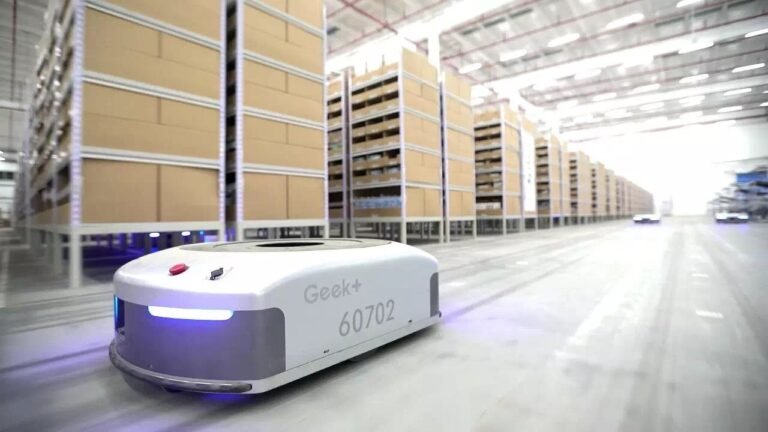
Geek+ (China)
Geek+ dominates AMR markets with AI-driven solutions for e-commerce, retail, and manufacturing.
- "Goods-to-Person" Systems: Shelf-to-person, bin-to-person, and pallet-to-person robots boosting efficiency 200–300%
- Global Scalability: 10% global AMR market share; deployed in 40+ countries
- RaaS Model: Robot-as-a-Service options for flexible automation investment

Quicktron (China)
Quicktron specializes in flexible AMR systems for high-mix logistics, emphasizing innovation and global reach.
- Multi-Robot Collaboration: QuickBin system pairs picking and transport bots for dense storage.
- AI OS: "Phoenix 3.0" OS for optimized fleet management and rapid deployment.
- Overseas Expansion: Partnerships in Europe (e.g., Linde) and APAC; 25,000+ robots deployed.

MiR (Denmark)
MiR, a Teradyne subsidiary, designs user-friendly AMRs for manufacturing and healthcare.
- Payload Versatility: MiR250 (250 kg) to MiR1350 (1,350 kg) models
- Safety Leader: 13 ISO 13849-1 certifications for emergency stop and speed monitoring.
- Open Platform: Customizable top modules for trolleys, conveyors, or robotic arms.

Standard Robots (China)
Standard Robots is a leading Chinese AMR manufacturer specializing in high-precision industrial logistics. Founded in 2014, it serves global giants like Toyota and Huawei, with 6,000+ AMRs deployed across 3C electronics, semiconductors, and automotive sectors
- Combines LiDAR and cameras for <5mm positioning accuracy, dynamic obstacle avoidance, and zero reliance on magnetic tapes/QR codes. Adapts to narrow aisles and human-robot shared spaces
- Safety-certified (ISO 13849), 1.5T payload capacity, and 24/7 operation with auto-charging. Reduces manual labor by 70%
- Clients achieve 200-300% efficiency gains and breakeven within 12-15 months
How to choose the right battery for your AGV
While top AGV brands offer intelligent software and innovative navigation, none of them can function efficiently without a powerful, reliable battery system. As AGVs shift toward 24/7 operation, the battery becomes a mission-critical component. The following factors need to be considered when choosing AGV batteries.
Key Factors
Picking the best AGV battery is not just about the brand. Buyers need to check the technology and how much energy the battery holds. The battery must fit well with the AGV system. New AGV technology helps batteries work better and use less energy. These changes let AGVs run longer and break down less. Companies now make batteries that work with smart navigation and automation. Some batteries can be made special for different jobs. Safety is important, so batteries have BMS, heat protection, and ways to stop overcharging. The battery’s size and power must match the AGV for it to work right.
Feature | Lead-Acid Battery | Lithium Battery |
|---|---|---|
Typical Cycle Life | 500 – 1000 cycles | 2000 – 5000 cycles |
Weight | 30 – 70 lbs | 10 – 30 lbs |
Depth of Discharge | 50% | 80%-100% |
Charging Time | 8-12 hours | 1-5 hours |
Temperature Range | -20°C to 50°C | -20°C to 60°C |
Self-Discharge Rate | 3-5% per month | 1-3% per month |
Cost and Value
AGV batteries can cost a lot at first. But what matters most is how much value they give over time. Lithium-ion batteries, like LFP, are popular because they last longer and charge faster. Top brands add smart features like AI, wireless charging, and batteries you can swap out. Buyers should think about the first price and also about less downtime and easy care. In North America, more companies buy better batteries to save money and help the planet.
Aspect | Details |
|---|---|
Battery Chemistry | Lithium-ion (LFP) is safest and most efficient |
Innovation Focus | AI, wireless charging, smart BMS, modular design |
Cost Structure | High upfront cost, but lower long-term expenses |
Value Proposition | Customization, service reliability, IoT integration |
Support and Warranty
Support and warranty are very important for buyers. Top brands give warranties that cover problems with the battery for the whole time. These warranties do not cover if the battery is used wrong or not cared for. Taking care of the battery keeps the warranty good and helps it last longer. The process to get help is usually fast and simple, so AGVs do not stop working for long. Good brands have a history of helping customers and making returns easy.
Warranties fix problems for the whole time.
They do not cover bad use or poor care.
Easy claims mean less time waiting.
Good care keeps the warranty working.
Trusted brands help more and get fewer returns.
BSLBATT Lithium AGV Battery: Engineered for Maximum Uptime
BSLBATT is a leading Chinese manufacturer of industrial lithium batteries. With over a decade of experience and global deployments in 100+ countries, BSLBATT has developed an AGV battery solution tailored for today’s logistics needs. Key Advantages of BSLBATT AGV Batteries:
Fast Charging & Opportunity Charging: Charges 3–5× faster than lead-acid and supports charging during idle time for maximum uptime.
Long Life Cycle: Delivers 3,000–5,000+ cycles—up to 10 years of reliable performance.
Maintenance-Free: No watering, equalizing, or battery swapping—fully maintenance-free.
Smart BMS: Real-time monitoring of voltage, temperature, and current for safety and efficiency.
Flexible Design: Custom sizes and voltages (24V / 36V / 48V / 80V) for any AGV model or space.
Wide Temperature Tolerance: Performs reliably in cold storage and high-heat environments.
Conclusion
The rise of AGVs has reshaped modern logistics, and behind every successful deployment is a trusted brand leading the charge. From global giants like KUKA and ABB to innovative players like Geek+ and Quicktron, these AGV manufacturers are driving the future of smart automation with advanced technology, system integration, and intelligent mobility.
But even the best-designed AGVs are only as reliable as the power that drives them. That’s where battery technology plays a critical role.
BSLBATT lithium batteries are engineered to unlock the full potential of today’s AGVs. With fast charging, long service life, and smart energy management, BSLBATT provides the performance and reliability leading AGV brands demand, keeping fleets moving efficiently, shift after shift.