Peak shaving is the practice of reducing a facility's electricity draw from the grid during short periods of high demand, keeping consumption below a defined power threshold. For commercial and industrial users, demand charges can account for 30% to 70% of a total electricity bill. Utilities calculate demand charges based on the highest 15-minute average power draw recorded in a billing cycle, meaning a single brief surge in power use sets the charge for the entire month. By deploying battery energy storage to discharge during those peak moments, facilities reduce their measured peak demand and lower the demand charge on every subsequent bill. Combined with battery storage and operational adjustments, demand charges can be reduced by up to 30%.
A Battery Energy Storage System (BESS) is one of the most effective tools for executing peak shaving in commercial and industrial facilities. The system charges during off-peak hours when electricity is cheaper, then discharges automatically when site demand approaches a defined threshold, preventing the grid connection point from recording a higher peak. This article explains how demand charges work, how BESS executes peak shaving in practice, how it compares to load shifting, which facility types benefit most, and what financial returns a well-sized system can deliver.
How Demand Charges Are Calculated
Demand charges are billed based on peak power draw, not total energy consumption, which makes even a brief surge expensive for the entire billing period.
Commercial and industrial electricity bills typically carry two separate line items. The energy charge covers total kilowatt-hours consumed during the billing cycle. The demand charge is calculated differently: the utility measures average power draw at 15-minute intervals throughout the month and bills based on the single highest interval recorded, regardless of how briefly that peak occurred.
For example, a facility with a peak demand of 500 kW and a demand charge rate of $15 per kW pays $7,500 in demand charges for that month, even if the 500 kW peak lasted only 15 minutes. If the same facility keeps its peak demand below 400 kW, its demand charge is reduced to $6,000, resulting in savings of $1,500 per month from a single operational change.
This billing structure creates a strong financial incentive to control peak demand precisely. A manufacturing line startup, an HVAC system cycling on during a hot afternoon, or multiple large machines running simultaneously can each push the monthly reading higher than necessary. Peak shaving addresses exactly this problem by filling the gap between actual site load and the target threshold with stored energy from a battery system.
How BESS Executes Peak Shaving
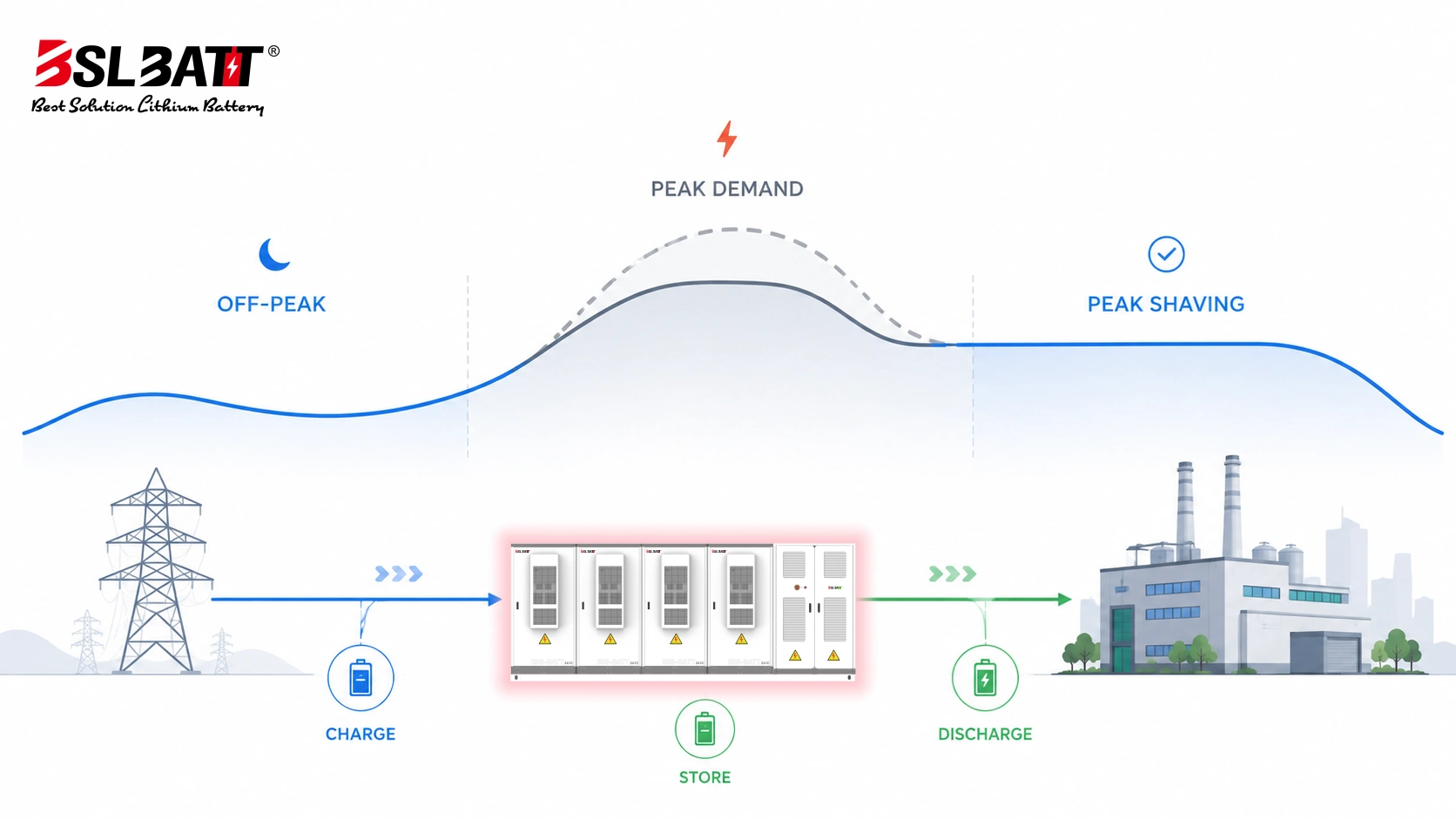
A BESS executes peak shaving by charging during low-demand periods and discharging automatically when site power draw approaches a defined threshold, reducing the net power drawn from the grid.
The process runs through four stages. During off-peak hours, the battery system charges from the grid or from on-site solar generation, storing energy at a lower cost. The Energy Management System (EMS) monitors the power flow at the grid connection point in real time, typically at intervals of one second or less. When measured demand approaches the preset threshold, the EMS triggers BESS discharge, and the battery supplies supplemental power directly to the facility. Net grid demand stays below the threshold and the utility does not record a higher peak for that interval.
The control algorithm adjusts discharge rate dynamically based on how close the measured load is to the threshold. If demand rises sharply, the BESS increases output. If demand drops, output reduces accordingly. This continuous adjustment keeps the facility within its target demand band without manual intervention.
Modern BESS units designed for C&I peak shaving support response times of less than one second, allowing them to react faster than most demand spikes develop. Battery capacity is sized according to the typical duration of peak demand at a site. For example, a facility that experiences two-hour afternoon peaks requires more energy storage capacity than one that only faces 30-minute morning demand spikes.
Peak Shaving vs Load Shifting

A BESS executes peak shaving by charging during low-demand periods and discharging automatically when site power draw approaches a defined threshold, reducing the net power drawn from the grid.
The process runs through four stages. During off-peak hours, the battery system charges from the grid or from on-site solar generation, storing energy at a lower cost. The Energy Management System (EMS) monitors the power flow at the grid connection point in real time, typically at intervals of one second or less. When measured demand approaches the preset threshold, the EMS triggers BESS discharge, and the battery supplies supplemental power directly to the facility. Net grid demand stays below the threshold and the utility does not record a higher peak for that interval.
The control algorithm adjusts discharge rate dynamically based on how close the measured load is to the threshold. If demand rises sharply, the BESS increases output. If demand drops, output reduces accordingly. This continuous adjustment keeps the facility within its target demand band without manual intervention.
Modern BESS units designed for C&I peak shaving support response times under one second, which is faster than most demand spikes develop. Battery capacity is sized based on how long peak periods typically last at the site. For example, a facility with two-hour afternoon peaks requires more storage than a facility with 30-minute morning spikes.
Which Facilities Benefit Most from Peak Shaving
Peak shaving delivers the greatest financial return for facilities where demand charges are high, peak periods are short and intense, and load profiles are difficult to reschedule.
Facilities that see the highest return on peak shaving investment share three characteristics: demand charges represent a significant share of their total electricity bill (above 30%), peak demand events are driven by equipment cycles or production processes that cannot easily be rescheduled, and they operate under a utility tariff that measures demand at 15-minute intervals.
Manufacturing plants and industrial facilities are the most common beneficiaries. Large motor startups, production line changes, and simultaneous equipment operation create sharp, short demand spikes that push monthly peak readings well above average load. Hospitals and data centers run high baseline loads with periodic peaks from HVAC and critical equipment that cannot be curtailed or shifted. Commercial buildings with large HVAC systems experience predictable afternoon peaks during summer months that are consistent enough to size a BESS accurately.
Facilities with demand charges between $10 and $20 per kW and peak events lasting 30 minutes to 2 hours generally achieve the strongest payback periods on battery storage investment. Sites where demand charges are below $5 per kW or where peaks are long and sustained see less financial benefit from peak shaving alone and may benefit more from load shifting or energy arbitrage strategies.
Peak Shaving with Solar Integration
Combining on-site solar generation with BESS strengthens peak shaving performance by giving the battery a lower-cost charging source and reducing baseline grid dependence.
In a solar-plus-storage configuration, the BESS charges from solar generation during daylight hours rather than from the grid. This lowers the cost of energy stored in the battery and reduces overall grid consumption throughout the day. During afternoon peak periods, when solar output is still available and demand is rising, the system can deploy both solar power and stored battery capacity simultaneously to keep grid draw below the demand threshold.
Solar generation alone does not solve the demand charge problem reliably. Cloud cover, seasonal variation, and mismatches between solar output timing and demand peaks mean that solar panels without storage still allow occasional high-demand intervals to set the monthly peak. Adding BESS removes this variability: the battery fills the gap when solar output is insufficient to cover the demand spike.
For facilities with rooftop or ground-mounted solar, integrating a BESS for peak shaving typically increases renewable energy utilization to above 80% of generated output, compared to approximately 30% to 40% for solar-only installations without storage.
Financial Returns and Payback Period
A factory paying over $50,000 per month in demand charges reduced its peak by 35% through BESS deployment combined with operational scheduling, saving over $500,000 annually with a payback period of under four years.
The financial return on peak shaving investment depends on three variables: the facility’s current demand charges, the size of BESS required to cover peak events, and the demand charge rate in the applicable utility tariff. Higher demand charge rates and larger, more frequent demand spikes produce faster payback periods.
For a mid-scale commercial facility with a monthly demand charge of $8,000 and a BESS system sized to reduce peak demand by 25%, annual savings total approximately $24,000. At a system cost of $80,000 to $100,000 installed, the simple payback period falls between three and four years. After payback, the savings continue for the remaining service life of the battery system, which for LFP-based BESS is typically 10 to 15 years and 6,000 or more charge-discharge cycles.
Demand charge rates vary significantly by utility and region. Facilities in markets with rates above $15 per kW, or those subject to ratchet clauses that carry peak readings forward into future months, see the strongest financial case for peak shaving. Before sizing a BESS, reviewing 12 months of utility bills to identify peak demand patterns and average monthly demand charges provides the most accurate basis for a business case.
How BSLBATT BESS Supports Peak Shaving
BSLBATT commercial and industrial BESS products are designed for peak shaving, demand charge reduction, backup power, and solar energy integration across a range of facility scales.
The ESS-GRID Cabinet Series is available in capacities from 200 kWh to 241 kWh per unit, with parallel configuration supporting larger installations. The system includes a built-in EMS that monitors the grid connection point in real time and controls charge and discharge automatically based on demand thresholds set during commissioning. Battery efficiency per cycle exceeds 95%, which limits the energy cost of each charge-discharge cycle and improves the economics of daily peak shaving operation.
Specification | BSLBATT C&I BESS |
Available capacities | 200 kWh, 215 kWh, 225 kWh, 241 kWh |
Cycle efficiency | Above 95% per cycle |
Cycle life | 6,000 cycles at 90% depth of discharge |
Applications | Peak shaving, demand response, backup power, solar integration |
Grid compatibility | Grid-tied, off-grid, hybrid |
Generator compatibility | Supported |
Communication protocols | CAN, RS485, Modbus |
View BSLBATT commercial and industrial energy storage systems
FAQ
What is peak shaving in simple terms?
Peak shaving is the practice of limiting how much power a facility draws from the grid during short periods of high demand. By keeping peak draw below a defined threshold, commercial and industrial users avoid the highest tier of demand charges on their electricity bill.
How much can peak shaving reduce electricity costs?
Using battery storage combined with operational adjustments, demand charges can be reduced by up to 30%. For facilities where demand charges represent 30% to 70% of the total electricity bill, this translates into significant annual savings. Actual results depend on the size of the BESS, the facility’s load profile, and the applicable demand charge rate.
Is peak shaving the same as load shifting?
No. Peak shaving reduces the maximum power draw from the grid at any given interval, targeting demand charges billed in $/kW. Load shifting moves energy consumption from high-rate to low-rate periods, targeting energy charges billed in $/kWh. Both strategies reduce electricity costs, but they address different line items on the bill. Many facilities apply both simultaneously.
How long does it take for a peak shaving BESS to pay back?
Payback periods typically range from three to five years for commercial and industrial installations, depending on demand charge rates, system size, and peak event frequency. For facilities with demand charge rates above $15 per kW, payback can fall below three years. After payback, savings continue for the remaining battery service life of 10 to 15 years.
For a full explanation of how battery energy storage systems store and release power, see What Is BESS: Battery Energy Storage Systems Explained.